To successfully configure and manage integrations, it is important to understand the core terminology used in Exalate. This guide explains the key concepts used when setting up and operating synchronization between systems.
Core concepts
System
A task management or service management platform connected to Exalate. Examples include Jira, Azure DevOps, ServiceNow, Salesforce, GitHub, and Zendesk. Each system participating in an integration processes synchronization independently.
Note: In the Exalate Console, System replaces the term Instance used in Exalate Classic.
Item
Any record you want to synchronize between systems. Depending on the platform, an item represents:
- Issues in Jira and GitHub
- Work items in Azure DevOps
- Incidents, problems, and change requests in ServiceNow
- Cases and opportunities in Salesforce
- Tickets in Zendesk, Freshdesk, and Freshservice
- Tasks in Asana
- Requests in Xurrent
Connector
A Connector is the component that allows Exalate to communicate with a specific platform. It exposes the platform’s APIs and data structures so that they can be used during synchronization.
Each supported platform has its own connector.
Replica
A replica is a copy of the information that is being transferred to the destination side. Exalate uses replicas to extract specific data and then send it over. You can use the replica in the Outgoing rules to specify which data should be sent. On the destination side, the replica object is used to represent the remote issue. It contains only the fields provided through the data filter on the source side.
You can view the replica details in the sync monitor.
The replica looks something like this:

In this way, you can see what information is being passed over from the local instance. The remote replica has a similar structure.
Note: The hubIssue represents the information that is passed and how you can access it. Whereas the replica is more than the hubIssue section. The replica is the entire payload to be transferred between platforms.
A pair of items that are related to each other through a synchronization relation. Any modification is synchronized towards the other item using the specifications of the relation.
Workspace and integration concepts
Workspace
A Workspace is a top-level organizational environment used to manage integrations, connections, and access across an organization.
To create or manage Workspaces in Exalate, see Manage Workspaces.
Integration
A container that links two systems and groups all connections between them. A single integration can contain multiple connections for different synchronization configurations.
Subscription
The billing plan associated with an integration. It defines the active item capacity and available features for that integration. Each integration has its own subscription.
Connection concepts
Connection
A Connection defines the synchronization relationship between two systems.
A connection determines how items are synchronized and contains the configuration responsible for handling the synchronization logic between both sides.
Multiple connections can exist between the same systems, for example to synchronize different projects or workflows.
Connection status
Active: The connection is running normally and processing sync transactions.
Deactivated: The connection has been manually paused. No sync transactions are processed until it is reactivated.
Error: The connection has encountered a functional issue preventing normal sync processing.
Sync Pair
A pair of items related to each other through a synchronization relationship. Any modification to one item is synchronized toward the other item using the specifications of that relationship.
Note: Sync Pair replaces the term Twin used in Exalate Classic.
Version concepts
Version
A Version is a saved snapshot of a connection configuration. Versions allow administrators to track configuration changes and restore earlier configurations if needed.
To learn more about managing your connection, or creating and editing versions, see Manage Connections.
Draft Version
A Draft Version is a configuration snapshot that can be edited but is not yet active. Drafts allow teams to prepare and validate configuration changes before applying them to live synchronization.
Active Version
The Active Version is the configuration currently used by a connection in production. Only one version can be active at a time.
Archived Version
An Archived Version is a historical snapshot of a configuration kept for reference or rollback. Archived versions are read-only.
Synchronization concepts
These terms describe how synchronization logic works.
Sync Rules
Sync Rules define how data is exchanged between systems.
They control:
- what data is shared
- how fields are mapped
- how values are transformed
Sync Rules typically contain outgoing and incoming logic.
Outgoing Script
Runs on the source system when an item changes. It selects which fields are written to the replica and sent to the destination system.
replica.priority = issue.priorityIncoming Script
Runs on the destination system when a replica is received. It reads values from the replica and maps them to fields in the local system.
issue.priority = nodeHelper.getPriority(replica.priority?.name)
Trigger
A Trigger defines the conditions under which items are automatically synchronized.
Triggers typically use queries or filters to detect items that should be brought under synchronization.
Sync Queue
The Sync Queue contains synchronization transactions waiting to be processed.
When an item changes, Exalate creates a synchronization event that is placed in the queue until it is processed.
Sync Status
The Sync Status indicates the current state of an item's synchronization.
Common statuses include:
- syncing
- error
- unlinked
Synchronization operations
Sync
Sync is the operation that brings an item under synchronization. When syncing begins, a corresponding item is usually created on the destination system.
Link
Establish a synchronization between two existing items across two systems.
Unlink
The Unlink operation stops synchronization between two items. After unlinking, the items remain in their respective systems but no further updates are synchronized.

Note: Unlink replaces the term Unexalate used in Exalate Classic.
Force Unlink
Force Unlink breaks the synchronization relationship between two items and clears any pending synchronization transactions.
Note: Force Unlink replaces the term Clean-up used in Exalate Classic.
Relink
Relink allows previously existing items in two systems to be linked together and synchronized.
Note: Relink replaces the term Bulk Connect used in Exalate Classic.
Bulk Sync
Bulk Sync allows multiple existing items to be synchronized at once, usually based on trigger conditions.

Note: Bulk Sync replaces the term Bulk Exalate used in Exalate Classic.
Bulk Unlink
Unlinks all items that match a trigger query in a single operation.
Console features
Test Run
A Test Run simulates synchronization without affecting live data. It allows administrators to preview how items would synchronize using a draft configuration.
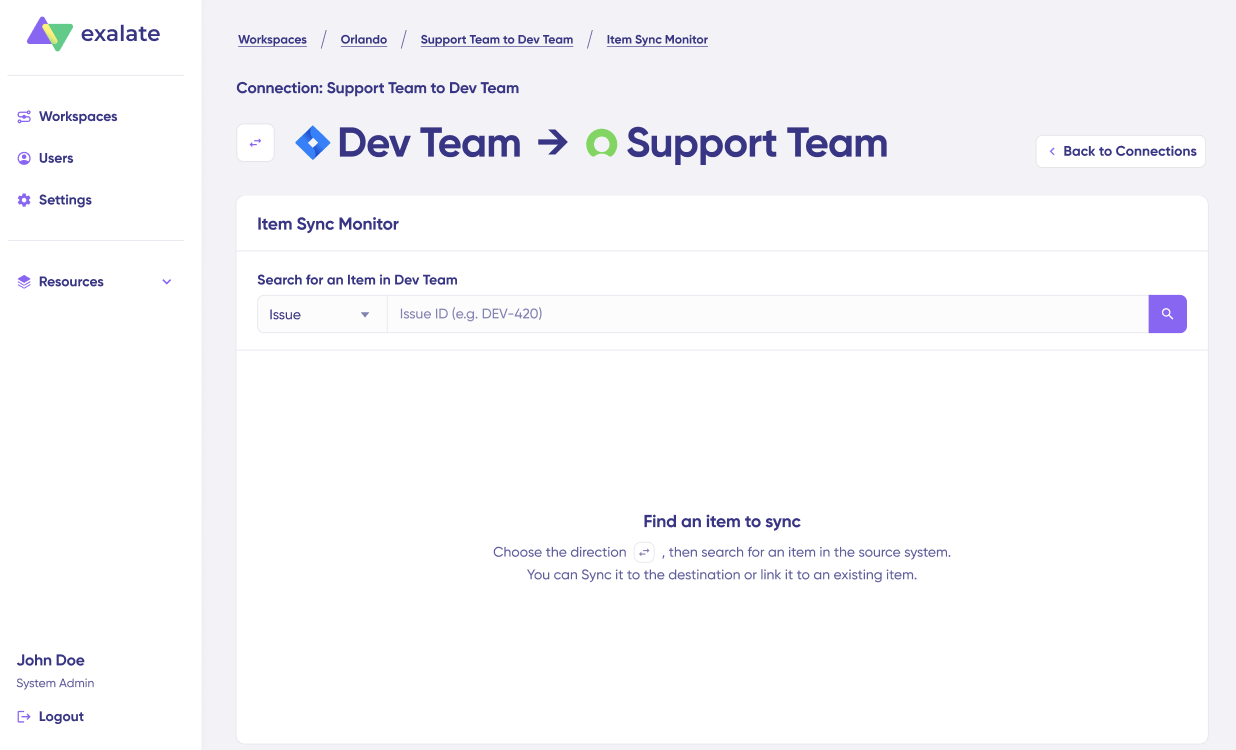
Item Sync Monitor
The Item Sync Monitor is the interface used to inspect synchronization activity for items.
Administrators can use it to:
- search synchronized items
- inspect Sync Pairs
- review sync events
- trigger manual operations
- troubleshoot synchronization errors
Item ID
A unique identification number that identifies a particular item across different task management systems. The Item ID is used for syncing, linking, and unlinking items between systems.
Note: Item ID replaces the term Entity URN used in Exalate Classic.